221. Maximal Square
1. Description
Given an m x n binary matrix filled with 0’s and 1’s, find the largest square containing only 1’s and return its area.
2. Example
Example 1
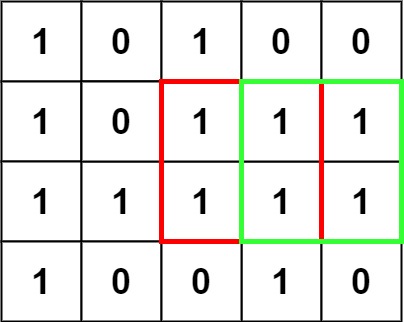
Input: matrix = [[“1”,“0”,“1”,“0”,“0”],[“1”,“0”,“1”,“1”,“1”],[“1”,“1”,“1”,“1”,“1”],[“1”,“0”,“0”,“1”,“0”]]
Output: 4
Example 2

Input: matrix = [[“0”,“1”],[“1”,“0”]]
Output: 1
Example 3
Input: matrix = [[“0”]]
Output: 0
3. Constraints
- m == matrix.length
- n == matrix[i].length
- 1 <= m, n <= 300
- matrix[i][j] is ‘0’ or ‘1’.
4. Solutions
Dynamic Programming
m = matrix.size(), n = matrix.front().size()
Time complexity: O(mn)
Space complexity: O(n)
class Solution {
public:
    int maximalSquare(const vector<vector<char>> &matrix) {
        const int m = matrix.size(), n = matrix.front().size();
        int max_length = 0;
        vector<int> max_length_end_at(n, 0);
        for (int i = 0; i < m; ++i) {
            int prev = max_length_end_at[0];
            max_length_end_at[0] = matrix[i][0] - '0';
            max_length = max(max_length_end_at[0], max_length);

            for (int j = 1; j < n; ++j) {
                int temp = prev;
                prev = max_length_end_at[j];
                if (matrix[i][j] == '0') {
                    max_length_end_at[j] = 0;
                } else {
                    max_length_end_at[j] =
                        min({temp, max_length_end_at[j], max_length_end_at[j - 1]}) + 1;

                    max_length = max(max_length_end_at[j], max_length);
                }
            }
        }

        return max_length * max_length;
    }
};