236. Lowest Common Ancestor of a Binary Tree

1. Description

Given a binary tree, find the lowest common ancestor (LCA) of two given nodes in the tree.
According to the definition of LCA on Wikipedia: “The lowest common ancestor is defined between two nodes p and q as the lowest node in T that has both p and q as descendants (where we allow a node to be a descendant of itself).”

2. Example

Example 1
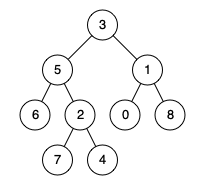
Example 1
Input: root = [3,5,1,6,2,0,8,null,null,7,4], p = 5, q = 1
Output: 3
Explanation: The LCA of nodes 5 and 1 is 3.

Example 2

Example 2
Input: root = [3,5,1,6,2,0,8,null,null,7,4], p = 5, q = 4
Output: 5
Explanation: The LCA of nodes 5 and 4 is 5, since a node can be a descendant of itself according to the LCA definition.

Example 3

Input: root = [1,2], p = 1, q = 2
Output: 1

3. Constraints

  • The number of nodes in the tree is in the range [2, 10$^{5}$].
  • -10$^{9}$ <= Node.val <= 10$^{9}$
  • All Node.val are unique.
  • p != q
  • p and q will exist in the tree.

4. Solutions

Depth-First Search && Two Scans

n is number of nodes in the root
Time complexity: O(n)
Space complexity: O(n)

class Solution {
public:
    TreeNode *lowestCommonAncestor(TreeNode *root, TreeNode *p, TreeNode *q) {
        vector<TreeNode *> p_path, q_path;
        traverse(root, p, p_path);
        traverse(root, q, q_path);

        TreeNode *candidate = root;
        for (int i = 0, n = min(p_path.size(), q_path.size()); i < n && p_path[i] == q_path[i];
             ++i) {
            candidate = p_path[i];
        }

        return candidate;
    }

private:
    bool traverse(TreeNode *root, TreeNode *target, vector<TreeNode *> &path) {
        if (root != nullptr) {
            path.push_back(root);

            if (root == target) {
                return true;
            }

            if (traverse(root->left, target, path) || traverse(root->right, target, path)) {
                return true;
            }

            path.pop_back();
        }

        return false;
    }
};
Depth-First Search && Single Scan

n is number of nodes in the root
Time complexity: O(n)
Space complexity: O(n)

class Solution {
public:
    TreeNode *lowestCommonAncestor(TreeNode *root, TreeNode *p, TreeNode *q) {
        if (root == nullptr || root == p || root == q) {
            return root;
        }

        TreeNode *left = lowestCommonAncestor(root->left, p, q);
        TreeNode *right = lowestCommonAncestor(root->right, p, q);

        if (left != nullptr && right != nullptr) {
            return root;
        }

        return left != nullptr ? left : right;
    }
};
comments powered by Disqus