25. Reverse Nodes in k-Group
1. Description
Given the head of a linked list, reverse the nodes of the list k at a time, and return the modified list.
k is a positive integer and is less than or equal to the length of the linked list. If the number of nodes is not a multiple of k then left-out nodes, in the end, should remain as it is.
You may not alter the values in the list’s nodes, only nodes themselves may be changed.
2. Example
Example 1
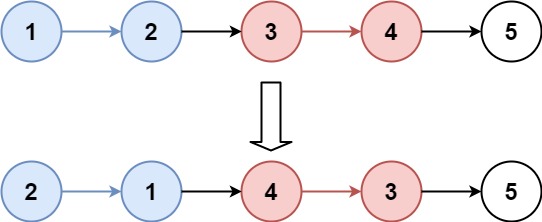
Input: head = [1,2,3,4,5], k = 2
Output: [2,1,4,3,5]
Example 2
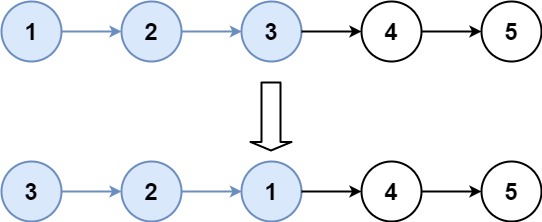
Input: head = [1,2,3,4,5], k = 3
Output: [3,2,1,4,5]
3. Constraints
- The number of nodes in the list is n.
- 1 <= k <= n <= 5000
- 0 <= Node.val <= 1000
4. Solutions
Linked List
n is the number of nodes in head
Time complexity: O(n)
Space complexity: O(1)
| |