1. Description
Given an n-ary tree, return the level order traversal of its nodes' values.
Nary-Tree input serialization is represented in their level order traversal, each group of children is separated by the null value (See examples).
2. Example
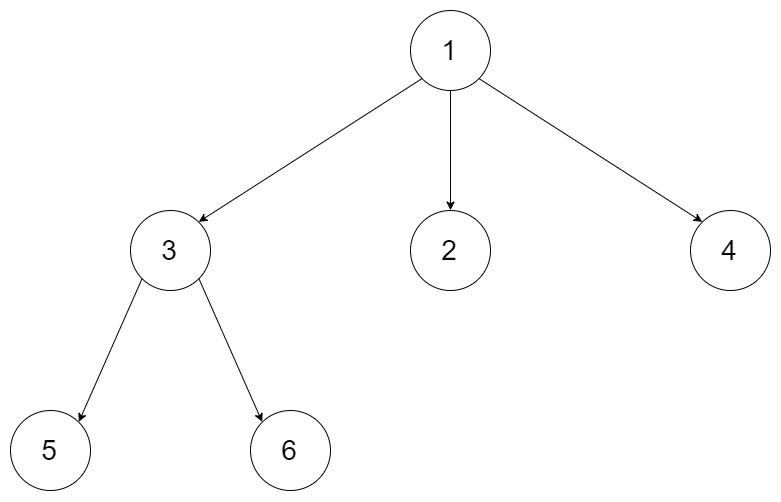
Example 1
Input: root = [1,null,3,2,4,null,5,6]
Output: [[1],[3,2,4],[5,6]]
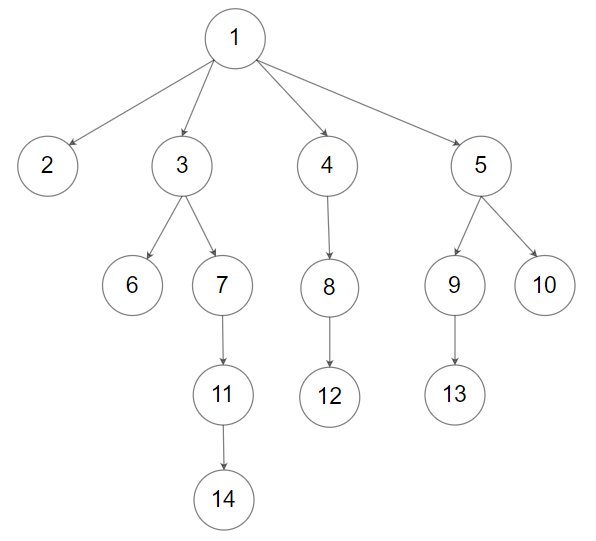
Example 2
Input: root = [1,null,2,3,4,5,null,null,6,7,null,8,null,9,10,null,null,11,null,12,null,13,null,null,14]
Output: [[1],[2,3,4,5],[6,7,8,9,10],[11,12,13],[14]]
3. Constraints
- The height of the n-ary tree is less than or equal to 1000
- The total number of nodes is between [0, 10$^{4}$]
4. Solutions
Breadth-First Search
n is the number of nodes in i_root
Time complexity: O(n)
Space complexity: O(n)
 1
 2
 3
 4
 5
 6
 7
 8
 9
10
11
12
13
14
15
16
17
18
19
20
21
22
23
24
25
26
27
28
29
30
31
32
33
34
35
36
37
38
39
40
41
| class Solution
{
public:
// vector<vector<int>> levelOrder(Node* root)
vector<vector<int>> levelOrder(Node *i_root)
{
if(!i_root) return vector<vector<int>>{};
vector<vector<int>> result;
queue<Node *> currentLevelNodes{{i_root}};
queue<Node *> nextLevelNodes;
vector<int> levelNodesValue;
while(!currentLevelNodes.empty() || !nextLevelNodes.empty())
{
if(currentLevelNodes.empty())
{
result.push_back(levelNodesValue);
levelNodesValue.clear();
swap(currentLevelNodes, nextLevelNodes);
}
else
{
auto node = currentLevelNodes.front();
currentLevelNodes.pop();
levelNodesValue.push_back(node->val);
for(auto iter : node->children)
{
if(iter) nextLevelNodes.push(iter);
}
}
}
result.push_back(levelNodesValue);
return result;
}
};
|
Recursion
n is the number of nodes in i_root
Time complexity: O(n)
Space complexity: O(n)
 1
 2
 3
 4
 5
 6
 7
 8
 9
10
11
12
13
14
15
16
17
18
19
20
21
22
23
24
25
26
| class Solution
{
private:
vector<vector<int>> result;
void traverseNode(Node *i_root, int level)
{
if(!i_root) return;
if(result.size() <= level) result.push_back(vector<int>{});
result[level].push_back(i_root->val);
for(auto child : i_root->children)
{
traverseNode(child, level + 1);
}
}
public:
// vector<vector<int>> levelOrder(Node* root)
vector<vector<int>> levelOrder(Node *i_root)
{
traverseNode(i_root, 0);
return result;
}
};
|