1. Description
Given a root node reference of a BST and a key, delete the node with the given key in the BST. Return the root node reference (possibly updated) of the BST.
Basically, the deletion can be divided into two stages:
- Search for a node to remove.
- If the node is found, delete the node.
2. Example
Example 1
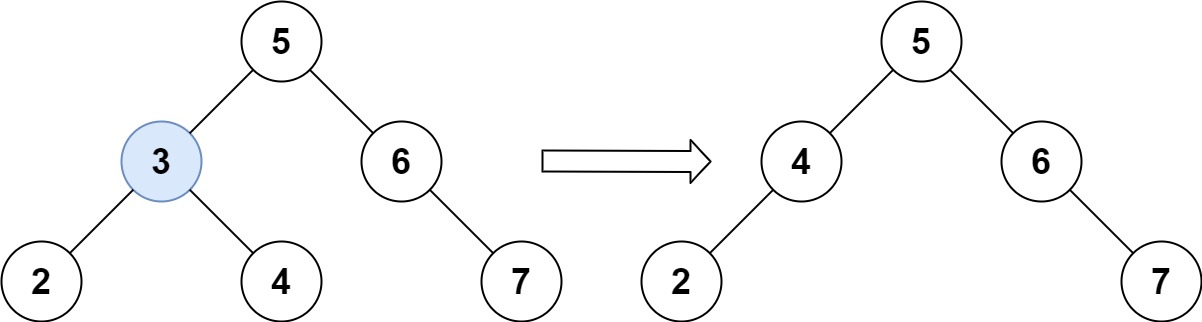
Input: root = [5,3,6,2,4,null,7], key = 3
Output: [5,4,6,2,null,null,7]
Explanation: Given key to delete is 3. So we find the node with value 3 and delete it.
One valid answer is [5,4,6,2,null,null,7], shown in the above BST.
Please notice that another valid answer is [5,2,6,null,4,null,7] and it’s also accepted.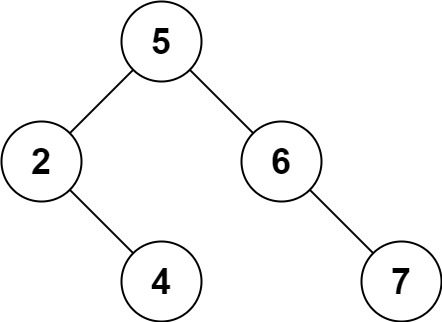
Example 2
Input: root = [5,3,6,2,4,null,7], key = 0
Output: [5,3,6,2,4,null,7]
Explanation: The tree does not contain a node with value = 0.
Example 3
Input: root = [], key = 0
Output: []
3. Constraints
- The number of nodes in the tree is in the range [0, 10$^4$].
- -10$^5$ <= Node.val <= 10$^5$
- Each node has a unique value.
- root is a valid binary search tree.
- -10$^5$ <= key <= 10$^5$
4. Solutions
Iteration
n is the number of nodes in root
Time complexity: O(n)
Space complexity: O(1)
| |