1. Description
Given the root of a binary search tree and the lowest and highest boundaries as low and high, trim the tree so that all its elements lies in [low, high]. Trimming the tree should not change the relative structure of the elements that will remain in the tree (i.e., any node’s descendant should remain a descendant). It can be proven that there is a unique answer.
Return the root of the trimmed binary search tree. Note that the root may change depending on the given bounds.
2. Example
Example 1
Input: root = [1,0,2], low = 1, high = 2
Output: [1,null,2]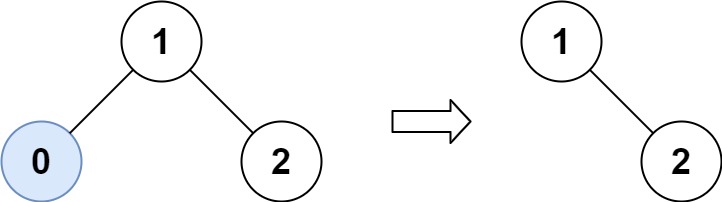
Example 2
Input: root = [3,0,4,null,2,null,null,1], low = 1, high = 3
Output: [3,2,null,1]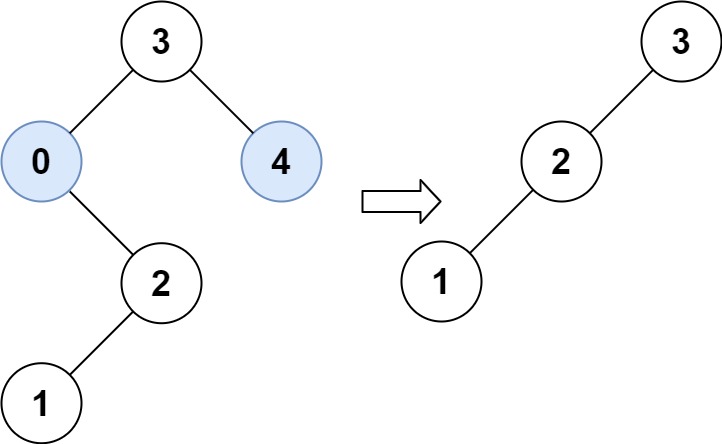
Example 3
Input: root = [1], low = 1, high = 2
Output: [1]
Example 4
Input: root = [1,null,2], low = 1, high = 3
Output: [1,null,2]
Example 5
Input: root = [1,null,2], low = 2, high = 4
Output: [2]
3. Constraints
- The number of nodes in the tree in the range [1, 10$^{4}$].
- 0 <= Node.val <= 10$^{4}$
- The value of each node in the tree is unique.
- root is guaranteed to be a valid binary search tree.
- 0 <= low <= high <= 10$^{4}$
4. Solutions
Two Pointers
n is the number of nodes in m_root
Time complexity: O(n)
Space complexity: O(1)
| |