688. Knight Probability in Chessboard

1. Description

On an n x n chessboard, a knight starts at the cell (row, column) and attempts to make exactly k moves. The rows and columns are 0-indexed, so the top-left cell is (0, 0), and the bottom-right cell is (n - 1, n - 1).
A chess knight has eight possible moves it can make, as illustrated below. Each move is two cells in a cardinal direction, then one cell in an orthogonal direction.
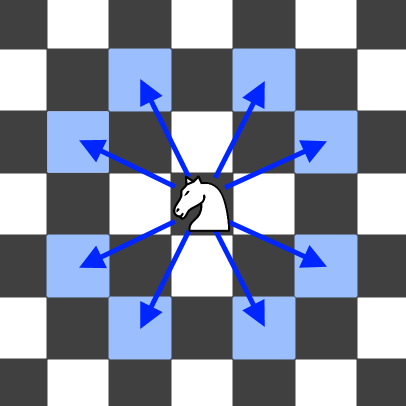
Sample
Each time the knight is to move, it chooses one of eight possible moves uniformly at random (even if the piece would go off the chessboard) and moves there.
The knight continues moving until it has made exactly k moves or has moved off the chessboard.
Return the probability that the knight remains on the board after it has stopped moving.

2. Example

Example 1

Input: n = 3, k = 2, row = 0, column = 0
Output: 0.06250
Explanation: There are two moves (to (1,2), (2,1)) that will keep the knight on the board.
From each of those positions, there are also two moves that will keep the knight on the board.
The total probability the knight stays on the board is 0.0625.

Example 2

Input: n = 1, k = 0, row = 0, column = 0
Output: 1.00000

3. Constraints

  • 1 <= n <= 25
  • 0 <= k <= 100
  • 0 <= row, column <= n - 1

4. Solutions

Dynamic Programming

Time complexity: O(kn$^2$)
Space complexity: O(n$^2$)

class Solution {
public:
    double knightProbability(int n, int k, int row, int column) {
        vector<vector<double>> probability(n, vector<double>(n, 0.0));
        probability[row][column] = 1.0;

        const array<pair<int, int>, 8> directions{
            {{2, 1}, {2, -1}, {-2, 1}, {-2, -1}, {1, 2}, {1, -2}, {-1, 2}, {-1, -2}}};

        for (int step = 0; step < k; ++step) {
            vector<vector<double>> next(n, vector<double>(n, 0.0));
            for (int i = 0; i < n; ++i) {
                for (int j = 0; j < n; ++j) {
                    if (probability[i][j] < 1e-10) {
                        continue;
                    }

                    for (const auto &[x, y] : directions) {
                        int r = i + x;
                        int c = j + y;

                        if (0 <= r && r < n && 0 <= c && c < n) {
                            next[r][c] += probability[i][j] / 8.0;
                        }
                    }
                }
            }

            probability = move(next);
        }

        double result = 0.0;
        for (int i = 0; i < n; ++i) {
            for (int j = 0; j < n; ++j) {
                result += probability[i][j];
            }
        }

        return result;
    }
};
comments powered by Disqus