1. Description
You are given an m x n integer array grid where grid[i][j] could be:
- 1 representing the starting square. There is exactly one starting square.
- 2 representing the ending square. There is exactly one ending square.
- 0 representing empty squares we can walk over.
- -1 representing obstacles that we cannot walk over.
Return the number of 4-directional walks from the starting square to the ending square, that walk over every non-obstacle square exactly once.
2. Example
Example 1

Input: grid = [[1,0,0,0],[0,0,0,0],[0,0,2,-1]]
Output: 2
Explanation: We have the following two paths:
- (0,0),(0,1),(0,2),(0,3),(1,3),(1,2),(1,1),(1,0),(2,0),(2,1),(2,2)
- (0,0),(1,0),(2,0),(2,1),(1,1),(0,1),(0,2),(0,3),(1,3),(1,2),(2,2)
Example 2
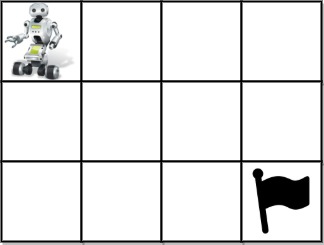
Input: grid = [[1,0,0,0],[0,0,0,0],[0,0,0,2]]
Output: 4
Explanation: We have the following four paths:
- (0,0),(0,1),(0,2),(0,3),(1,3),(1,2),(1,1),(1,0),(2,0),(2,1),(2,2),(2,3)
- (0,0),(0,1),(1,1),(1,0),(2,0),(2,1),(2,2),(1,2),(0,2),(0,3),(1,3),(2,3)
- (0,0),(1,0),(2,0),(2,1),(2,2),(1,2),(1,1),(0,1),(0,2),(0,3),(1,3),(2,3)
- (0,0),(1,0),(2,0),(2,1),(1,1),(0,1),(0,2),(0,3),(1,3),(1,2),(2,2),(2,3)
Example 3

Input: grid = [[0,1],[2,0]]
Output: 0
Explanation: There is no path that walks over every empty square exactly once.
Note that the starting and ending square can be anywhere in the grid.
3. Constraints
- m == grid.length
- n == grid[i].length
- 1 <= m, n <= 20
- 1 <= m * n <= 20
- -1 <= grid[i][j] <= 2
- There is exactly one starting cell and one ending cell.
4. Solutions
Depth-First Search && Backtracking
m = grid.size(), n = grid.front().size()
Time complexity: O(4$^{mn}$)
Space complexity: O(mn)
| |